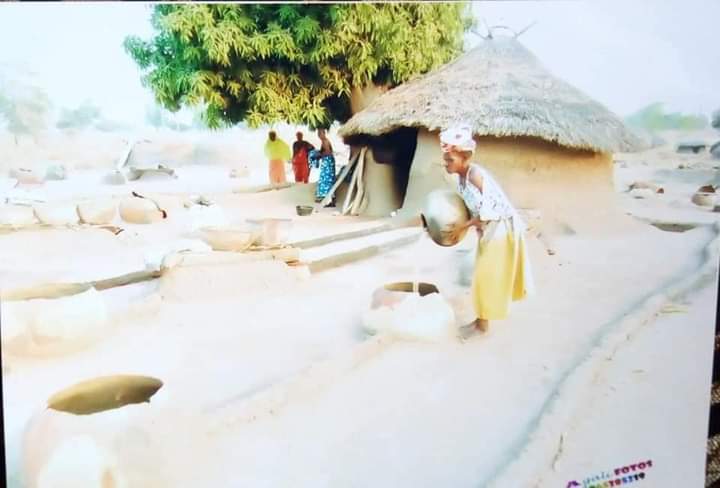
The ancient town of Keana has perhaps earned fame for itself across what is today referred to as northern Nigeria because of one thing-salt mining.This piece, gives a break-taking account of what it takes to produce salt in Keana, especially against the backdrop of strict traditional codes which inform the entire spectrum of salt mining in the chiefdom.
Salt, an invaluable food additive has its roots firmly tied to the history of the Keana people of Nasarawa State from primordial times. Indeed such was the run of events that the salt consumed in virtually all the homes of the inhabitants of the middle belt area came from Keana at least before the federation commenced the importation of table salt from Europe.
However, what fundamentally makes Keana Salt unique results not so much from its indispensable place in the culinary of the peoples of the middle belt as the sacred cultural imperatives which inform the Salt production processes in the ancient town.

As it is, the production process of the salt is guided by some strict and we’ll established codes which every citizen of the “Salt Village”, (communities that sprang up within the various salt pond which came into being since the first one was discovered by Akyana Adi, who founded Keana after the break up of the Kwararafa empire,must uphold.Every salt village (otherwise referred to as Akyana) is administered by a privileged clan the Ogyes, Osikigu as the head.And from this or other clans, a queen-Inole is picked, whose responsibility is to see to the day to day administration of Akyana. She is assisted by a man Osikigu who act as the prime Minister. Both have shrines to whom the pay periodic visit and pray for cosmic blessings. Both of them also have lieutenant who assist in the running the Akyana and understanding the preparation of the food of the duo. It is interesting to note that Inole and Osikigu must never eat the food cooked by a woman. And it is an abomination for Inole to step into the salt pond, a violation of which would automatically render her blind. It is worthy of note that Inole and Osikigu can only be appointed and removed by the paramount ruler of Keana Chiefdom the Osana, though often in close consultation with the women operating in each of the Akyana. As a rule, the production of salt holds annually during the dry season only. And as a first step, the large pond of salt water, which is found in every salt village, is drained. Prior to the advent of mechanized means of draining the water, a large number of strong and energetic men are detailed to drained the water with calabash. This lasts for at least a month, the end of which exercise is signalled by drumming. On the orders of the Osana, the men then return home. The populace would then be informed that the Inole would in the evening be returning to the Akyana. On the same day, the Ogyes would leave for Obowayo in the night.Suffice it to say that Obowayo is a sacred pond about 8kms away from Akyana Gbogbo, one of two major salt villages in the chiefdom. ( The second one is Akyana Ipwole while the smaller villages include Oze, Okunamase, Adaka, Okidi, Agyese, Omwadefu, Omwasibiya, Omwa Elalonye and Omwa Oguu).
At Obowayo, the Ogyes would, amidst drumming, perform some rituals. Indeed so sacred and divine are the ceremonies that the water in the pond would sway to the beat of the drums, while no leaf from the surrounding trees would, as the occasion lasts, drop on the pond. The ceremony lasts through the night with people eating and drinking, though they must not drink from the pond.
Thereafter, all the traditional tittle holders in Keana would proceed to Osikigu shrine where they would pour libations, eat and drink and head for Inole’s shrine..
Here, outstanding issues dwelling on the health of the community would be thrashed out. Those found guilty pay fines of goats which are used as sacrifice to the Gods. The title holders would conclude the ritual by paying homage to Inole saying “Owaji” and immediately proceeding to the deputy of Inole Ogbole Inole where they also pay homage to her, saying “Ozowure”. The title holders then return home and salt production can now start. It must be stressed that the actual act of mining this item is done in huts which are exclusively individual possessions handed down from generation pasts. As earlier stated, water is drained from the ponds as arrangement to commence salt mining kick off. A day or two would then be set aside for the people of the chiefdom to catch the fishes that are in the pond. This is done under the strict supervision of Osikigu. With the fishing festival now over, every woman would now be free to fetch the salty water to her “Opu” (hut) using earthen pots as metal bucket or basins are disallowed. The next stage of salt production process is “Ikpuru”. Here the salty water is poured on specially made Sandy salt beds and left for about a week to dry. This leads us to the next stage -“Otagyiso” during which the whitish surface of the salt bed is removed into “Azuzu”. These are three perforated pots seated on a tripod- plank (Awuwa) into which the salty sand, now finely mixed with water is left to filter into the “Okiyi” pot the end result of this process is highly concentrated salt water, referred to as “Abiya”. It is this Abiya that is collected and boiled for hours until the water evaporate, leaving high quality table salt which is scoped and sold to customer.
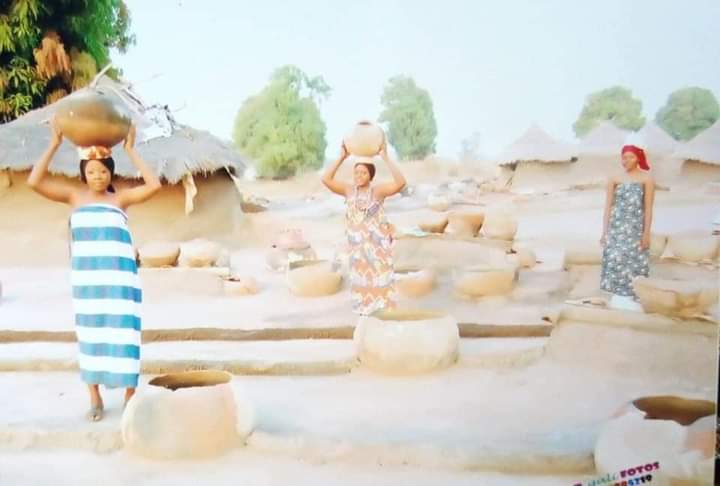
Mention must be made that the queen of Akyana-Inole must be the person to kick off the boiling of the Abiya and in recognition of her revered and exalted position, all women, for every three trips of salt water which the fetch in the day time must donate the table salt gotten from two of the trips to the Inole.However all operation undertaken in the night does not attract these obligations. After seven days, the salt pond would be closed to the salt producers. Thereafter it would be reopened for business and closed again after seven days. This policy continues for the four months which the production of salt is undertaken. Suffice it to say that the bans are occasioned by need to allow for enough availability of salt water. Osikigu normally hands-down severe sanction on those who violate the bans.
Akyana, within this period, is a beehive of activities. Most people spend all their time here. And the mode of trading is essentially by barter. Food and drinks are usually exchanged for salt. May I quickly add that the medium of communication is as expected, the local dialect laced slangs and language codes. In the fourth month of salt production, the Osana would ride his horse to Obowayo to offer sacrifice. From here, he would proceed to Akyana and take his seat in a spot referred to as “Amirikpa”. The entire womenfolk in Akyana would then pay their respects and offer the Osana, a bag (Obubu) of salt each. These are the bags the Osana takes home and gives out as gifts to visitors or individuals or the royalty in neighbouring towns and villages. With the raining seasons fast approaching, Osikigu accordingly intimate the Osana who decrees that everybody in Akyana should return home. Thereafter, Osikigu and Inole would take their leave to be followed by the remaining throng. #By_Moustapha_Eladoga_Ari

 Site Title